Seven-zone responsive support
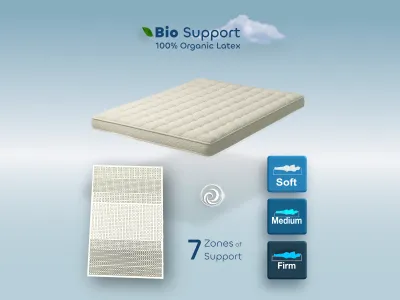
Seven zones run under the body: head, shoulder, back, pelvis, knees, legs and ankles. Each one carries a different share of your weight, so the heavy pelvis is held firmly while the lighter head and shoulders settle in. The bars show how support is distributed between the zones.
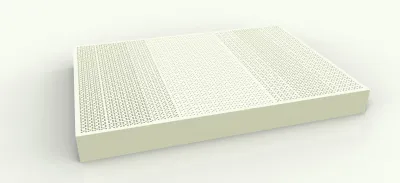
This is zoned latex support. The surface is not one flat firmness: where the body is heavy the latex carries more, and where the body is light or narrow it is softer, so every part meets the support it needs. Your firmness level itself, the regulation, is calculated from your height and weight and shown in the readout below.
In practice. A surface that carries your weight evenly instead of pushing back against the heavy parts.
Shoulder adaptation
The shoulder is the widest part of a side sleeper and it takes a large share of the load. The latex yields here, so the shoulder settles into the surface instead of being pushed back, and the spine can stay level.
On a surface that is too firm the shoulder and the shoulder blade are pushed up and back, the neck and upper spine twist, and pressure builds on one small area. In the shoulder zone the latex gives way under the shoulder and under the shoulder blade, spreads the pressure over the whole contour, and lets the head and spine stay in one line.
In practice. Less pressure on the shoulder, and a spine that stays straight from the neck to the pelvis.
Lumbar support
Under the waist the latex rises to meet the natural curve of the lower back. It supports the hollow without pushing into it, so the spine keeps its neutral line.
A side sleeper has a gap between the waist and the mattress. If nothing fills it, the spine sags into that gap and the lower back works all night to hold its line. In the lumbar zone the latex fills the gap, firmly enough to carry the waist and softly enough not to press into the curve.
In practice. The lower back can let go, because the mattress is holding the line.
Reinforced pelvic stability
The pelvis carries the most weight. This zone is reinforced, so the hips do not sink below the shoulders and the spine is not bent out of line.
If the pelvis sinks too far, the spine bends down into a hollow and the whole body hangs. The pelvic zone carries more, spreads the load over a wide area, and lets the hips sink only as far as comfort needs. This is the balance between adaptation and support.
In practice. A level pelvis and a straight spine, with no hammock.
Stretching effect
When the spine rests in a neutral line, the muscles around it can let go and the spine lengthens gently into its natural shape. The drawing shows the principle. It is not a medical measurement.
Seven vertebrae are drawn here in one straight line. On a surface that is too firm the line arches upward, and on one that is too soft it sags downward. In both cases the line breaks and the muscles stay tense to hold it.
In practice. A spine in one straight line, and muscles that can relax.
Soft-tissue and muscle relief
Latex is elastic. It gives under muscle and soft tissue and comes back, following your shape without holding it, so muscles are not working to push against the surface.
Muscle, fat and skin press into the surface as much as bone does. Natural latex yields under them and returns at once, so the soft tissue is relieved and the body does not have to fight the surface to find a comfortable position.
In practice. Muscles that let go, and the freedom to move without waking.
Pressure distribution and circulation comfort
Latex spreads your weight over a wider area, so no single point carries too much. Lower, more even pressure helps you stay comfortable and change position freely.
Where the body meets the surface, the latex follows the contour and shares the load. The lower and more even the pressure, the easier it is for the body to rest, and the less often you need to turn to find relief. A mattress supports comfort. It does not treat medical conditions, so if you have one, ask your doctor.
In practice. Even pressure and comfortable circulation through the night.
Real natural latex response
This is the real thing: a person on natural Dunlop latex. Open cells and high elasticity let it press in under load and return straight away, which is why it can support and adapt at the same time.
The photograph shows the surface in use: the latex presses in under the shoulder and the hip, and holds the waist. Open cells and natural elasticity give this immediate, even response.
In practice. A natural surface that supports and adapts at the same moment.